
On the coastThe hilltop is exposed: hot and shadeless at midday, breezy after dark. Parking near the top is limited in summer evenings, when many people come up for sunset.
From the seafront in Sarandë, look south-east and you will see a ridge with a line of grey wall along its crest. That is Lëkurës Castle (Kalaja e Lëkurësit), a fortress built in the 16th century under the Ottomans and named after the village of Lëkurës on the slopes nearby. It is not large, and much of it is ruined, but its position is superb. From the walls you look down over the whole of Sarandë's bay, across the strait to Corfu and south over the flat water of the Butrint lagoon.
Most visitors come for the view, and it is a good reason. But the castle also says something about this coast: about who controlled it, who watched it and why a hill above a small harbour mattered enough to fortify.
A fortress for a contested coast
The castle is generally dated to the first half of the 16th century, and it is said to have been built in the time of Sultan Suleiman the Magnificent, when the Ottoman Empire was at the height of its power. This was a frontier. Corfu, just across the strait, was held by Venice, and the Ottomans and Venetians fought repeatedly over the islands and coasts of the Ionian Sea. A fort on this ridge could watch the approaches to the harbour and the road south towards Butrint, which at various times was also in Venetian hands.
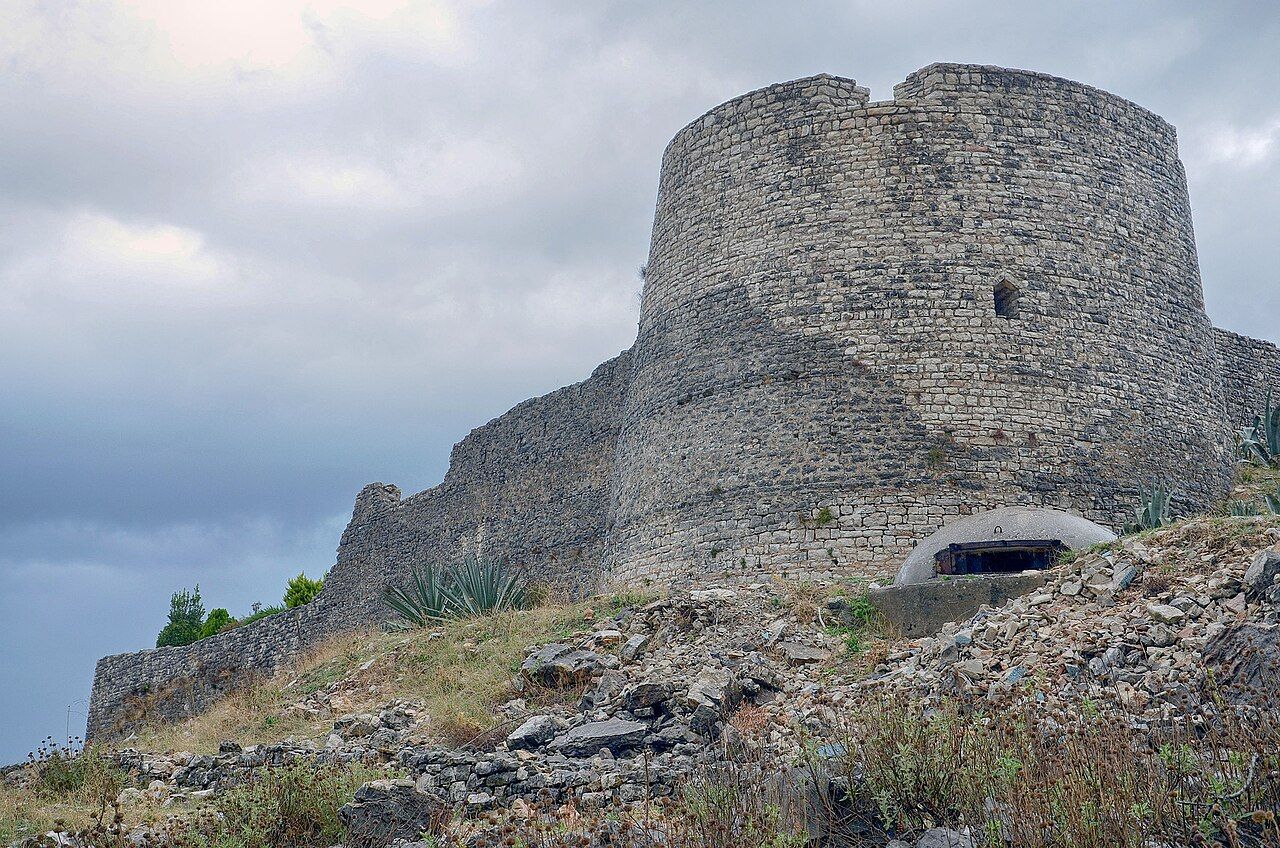
The exact story of its construction is not always clear, and you will hear different versions. What is certain is the purpose: a lookout and garrison post commanding the bay and the land routes around it. Over the following centuries the coast passed through many hands and the castle's role faded. Later, in the 20th century, the hill was again of military interest, and you can still see a small concrete bunker set into the slope below one of the towers, a survival of the communist period when such shelters were built across the whole of Albania.
What you see on the hilltop
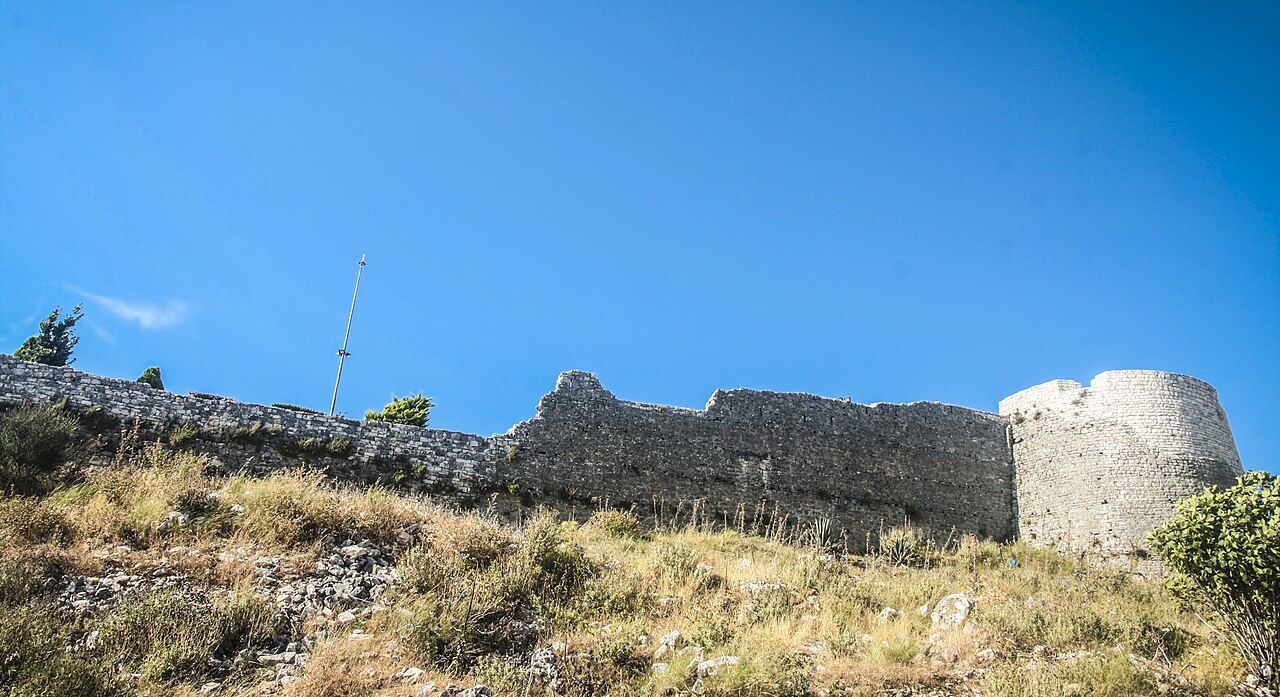
The fortress has a roughly rectangular plan with round towers at its corners, linked by thick walls of rough stone. Parts of the walls stand to a good height, especially along the side facing the slope, while elsewhere they have crumbled to low courses. Agave and scrub grow along their foot. Walk around the outside first to get a sense of the scale, then look at how the towers are placed to cover each other's walls.
Part of the site has been converted for visitors, with a paved terrace facing the sea where you can sit with a drink and watch the light change. It is a pleasant addition, though it does mean that the top of the hill feels less like a ruin and more like a viewpoint in the evenings. Outside the busiest hours, you can still walk along the walls in relative quiet.
There is no large museum here and little in the way of labels, so it helps to arrive knowing the outline of the history. Allow an hour or so, longer if you are staying for sunset.
The view: bay, lagoon and Corfu
Lëkurës is high enough to see the whole layout of the coast. To the north-west the town curves around its bay, its apartment blocks packed along the water and up the slopes behind. Straight ahead, the strait opens towards Corfu, whose long mountain ridge seems close enough to touch on a clear evening. To the south the land flattens out into the Butrint lagoon, a wide sheet of water ringed by low hills, with the road to Ksamil and Butrint running along its edge.
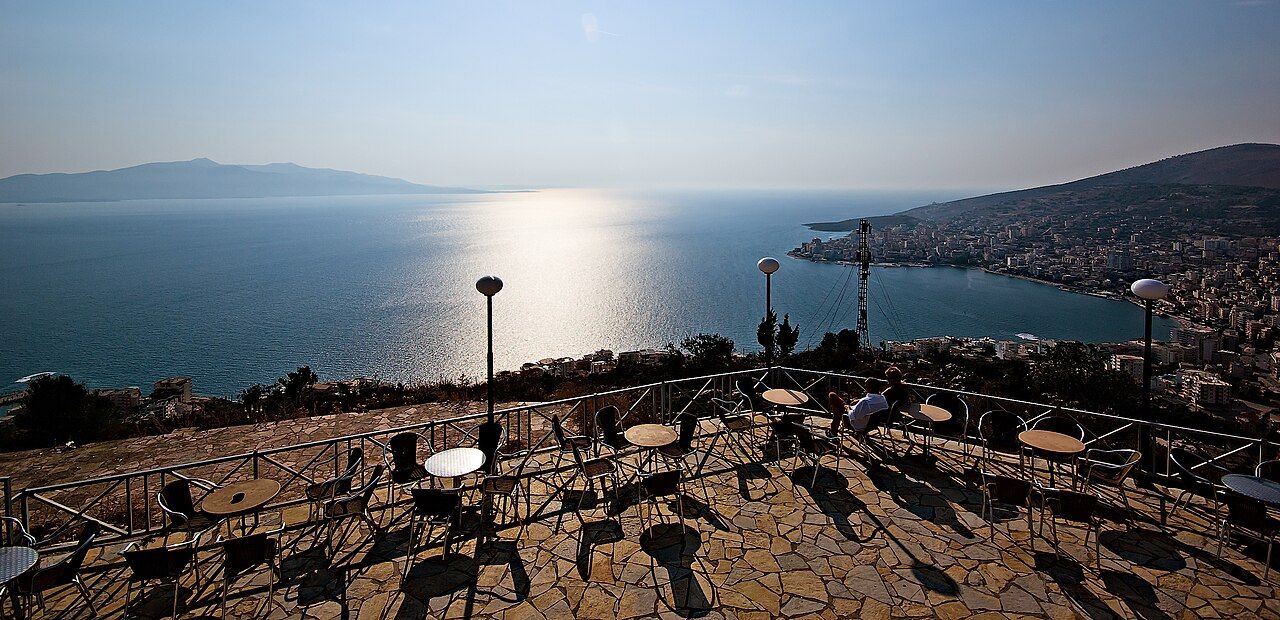
Sunset is the classic time. The sun drops behind Corfu or into the sea beside it, depending on the season, and the bay below turns gold and then deep blue as the lights of the town come on. In high summer the terrace and the space around it fill well before sunset, so come early if you want a spot by the wall. In spring and autumn the light is often clearer and the crowds lighter.
Morning has its own appeal. The air is usually sharper, the lagoon catches the light and you may have the walls nearly to yourself. It is also cooler for the walk up.
Onward · Butrint & KsamilThe Butrint lagoon and its mussel farmsThe climb up from the road
The castle sits a short distance out of the centre, off the road that leads south towards Butrint and Ksamil. A paved road climbs the hill to the top. By car or taxi it takes about ten minutes from the seafront, depending on traffic. Parking near the top is limited, and on summer evenings it can fill, so a taxi is often simpler.
Walking is possible but steep. The road climbs in bends with little shade, and in July and August the heat on the hillside is serious in the middle of the day. If you do walk, go early in the morning or late in the afternoon, wear proper shoes and carry water. Coming down after dark, a torch or phone light is useful on the unlit stretches.
- Time from the seafront: about ten minutes by road, much longer on foot.
- Time to allow: an hour for the walls and view, more for sunset.
Combining it with other sights
Because Lëkurës sits on the way south, it pairs well with a day around the lagoon. You could visit Butrint in the morning, before the heat and the tour groups, swim at Ksamil in the afternoon and stop at the castle on the way back for the evening light. Or keep it simple: walk the seafront in town, then take a taxi up for sunset and come back down for dinner.
If the history interests you, the castle is one of several layers of the past around Sarandë. In the town itself, the remains of ancient Onchesmos go back more than a thousand years earlier, and the ruined Byzantine monastery on the hill above town gave Sarandë its name. Together they make a compact introduction to the many hands that have held this stretch of coast.
Small practicalities
The hilltop is exposed to sun and wind. At midday there is almost no shade outside the terrace area, and after sunset it can feel noticeably cooler than the seafront, especially in spring and autumn. Bring a hat, water and a light layer. The ground around the walls is uneven and stony, so sandals with grip are better than flip-flops.
Take care near the edges of the walls and towers: there are few railings, and some stones are loose. Keep an eye on children. Leave the bunker and the ruins as you find them; climbing on fragile sections speeds up their decay.