
On the coastThe hill is open and hot in summer with little shade; go early or late. The approach road is narrow in places, and there is no shop at the top.
The name of the town is the best clue to this place. Sarandë comes from Agioi Saranta, the Greek for the Forty Saints, and the Forty Saints were the dedication of a Byzantine monastery on the hill above the bay. Today the monastery is a ruin, its walls broken and its roof long gone, but enough remains to give a strong sense of what stood here: vaulted lower rooms, the outline of a large church and a few faded fragments of painting.
It is quieter than the castle on the opposite ridge and less visited than the sites to the south. That is part of its appeal. You come up, walk among the stones, look out over the town and the strait, and leave with a better idea of how far back this harbour's story runs.
The Forty Martyrs and the town's name
The Forty Saints were the Forty Martyrs of Sebaste, Roman soldiers who, in Christian tradition, died for their faith in the early 4th century by being left to freeze on a lake in Asia Minor. Their story was widely told across the Byzantine world, and many churches were dedicated to them.
The monastery here is generally dated to the 6th century, the age of the emperor Justinian, when the Byzantine Empire built churches and fortifications throughout its Balkan provinces. It became an important religious centre on this stretch of coast, and over time its name passed to the harbour below. Saranta became Sarandë in Albanian. The ancient name of the harbour, Onchesmos, survives mainly in history books and in the ruins in the centre of town.
What still stands
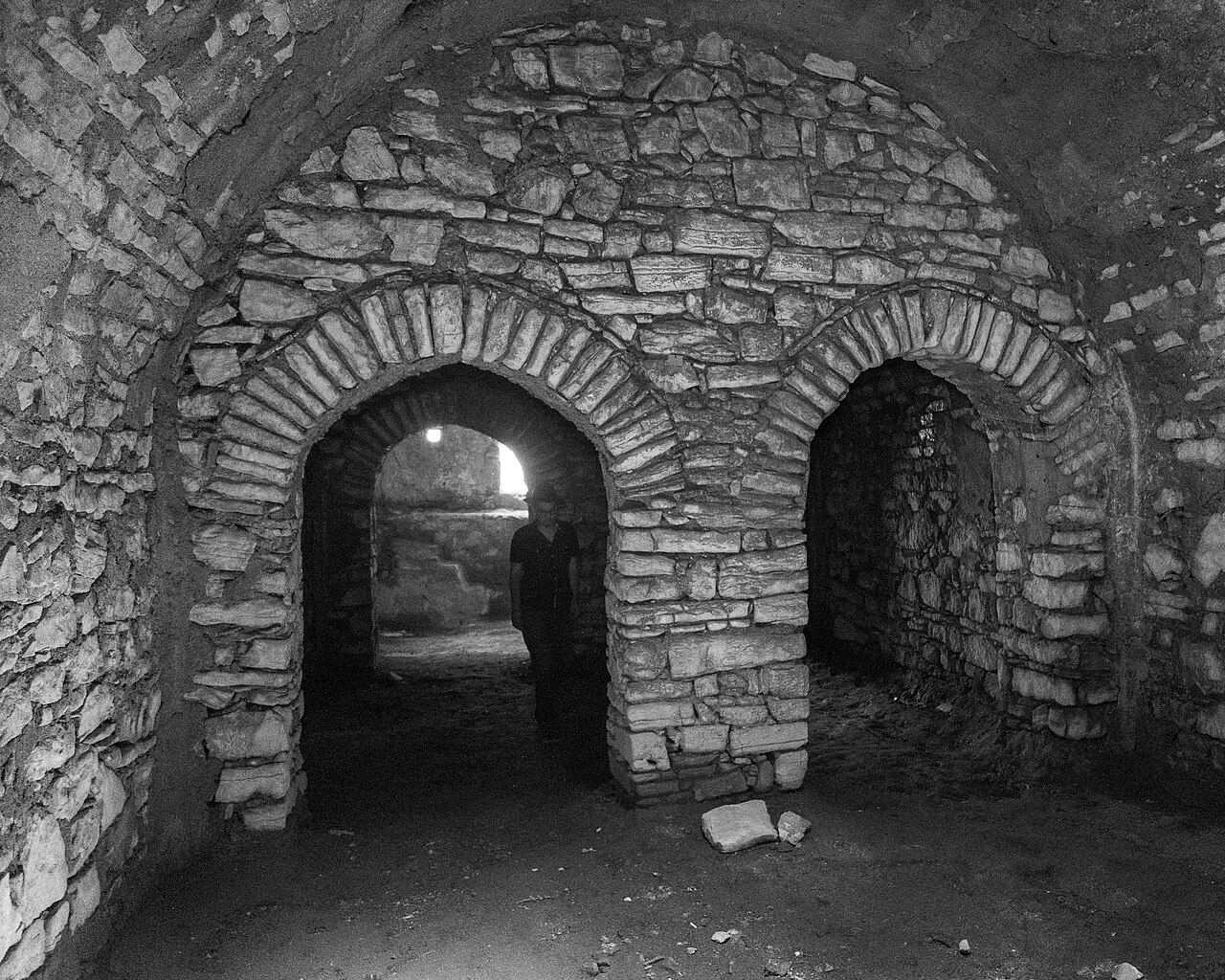
The main church was a large building, and its plan can still be traced in the walls and foundations on the hilltop. Much of the upper structure has fallen, but the lower level, with its vaulted chambers and arched passages, survives better. These underground rooms are cool even in summer, and the play of light through the arches gives them a strong atmosphere.
The monastery suffered badly in the 20th century. It was damaged during the Second World War, when the hill had military value, and further harm came in later decades when religious buildings across Albania were neglected or closed under the communist regime. What you see today is the result of those losses, with some conservation work since.
Onward · SarandëThe ancient synagogue in the middle of town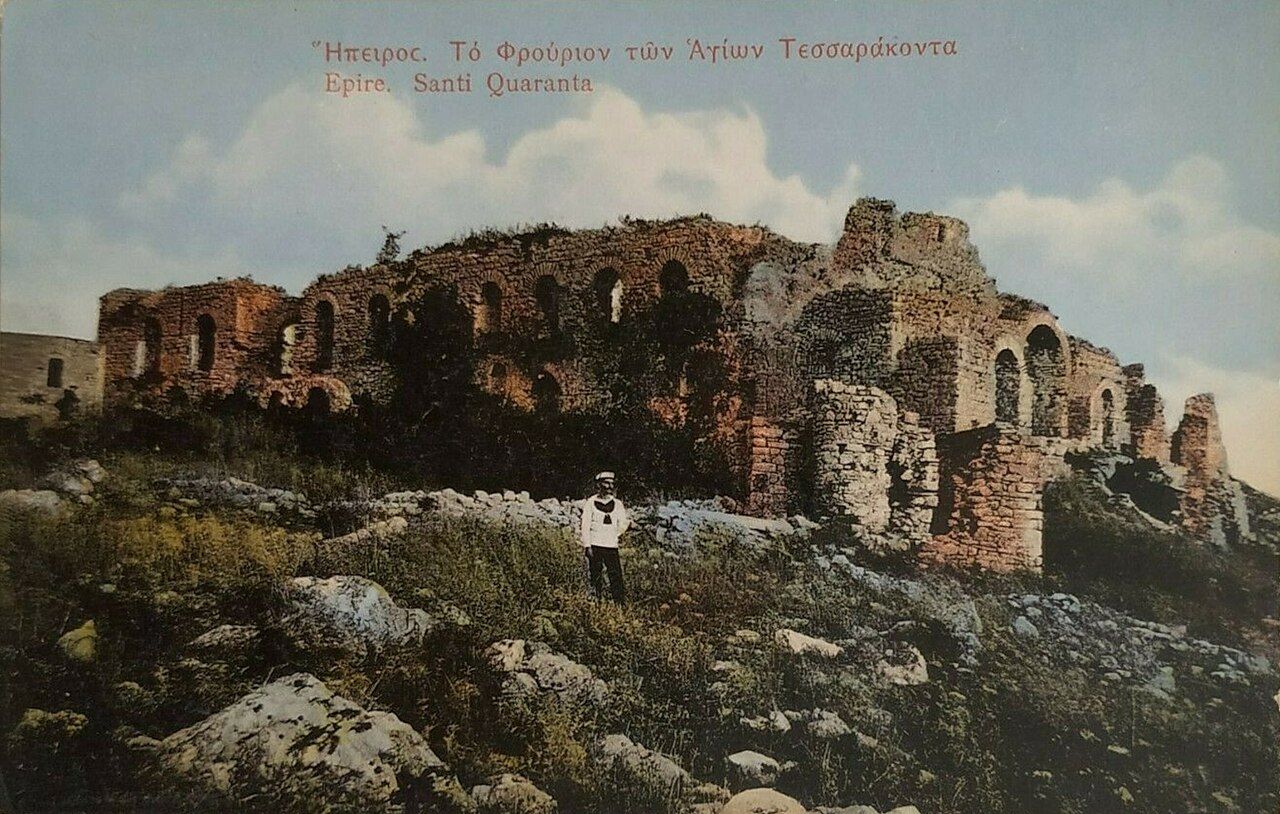
Early 20th-century postcards show how much more of the building stood before the war. In them the long walls still rise high above the hillside, pierced by rows of arched openings, and the captions give the name the town carried in Italian and in much Western usage at the time: Santi Quaranta, the Forty Saints. Comparing those images with the walls today is the clearest way to see what the last century took away.
Frescoes in fragments
The church was once painted, and traces of the frescoes survive in places, especially in the more sheltered parts of the lower level. Do not expect complete scenes: what remains is mostly fragments, patches of colour, the edge of a figure or a band of decoration. Look closely, in good light, and let your eyes adjust in the darker rooms. A small torch helps.
These surviving pieces are fragile and exposed. Do not touch the painted surfaces, and avoid leaning against walls where plaster remains. Even small amounts of handling speed up their loss.
The view from the hill
The site's position explains why it was chosen. From the hilltop you look down over the whole of Sarandë and its bay, out across the strait to the mountains of Corfu and along the coast in both directions. On a clear day the view is wide enough to make sense of the whole area, from the town to the lagoon in the south. On the opposite ridge you can pick out Lëkurës Castle, and from up here the shape of the horseshoe bay is easy to see.
Late afternoon is a good time, when the light softens and the heat drops. Morning visits are cooler and quieter, and the light over the sea is often clear.
Driving out from Sarandë
The monastery sits on a hill above the town, reached by a road that climbs from the edge of Sarandë. By car or taxi it takes about fifteen minutes from the seafront. The last part of the road is narrow in places, and parking at the top is informal. Walking up is possible for keen walkers, but it is a steep climb with little shade, so in summer go early or late and carry plenty of water.
- Time to allow: about an hour on site, more if you linger for the view.
- Facilities: none to speak of at the top; bring what you need.
Where it fits in a coast day
The monastery pairs well with the other historic sites around town. Start with the ruins of ancient Onchesmos in the centre, drive up to the monastery for the view, and finish the day on the seafront promenade as the evening stroll begins. Together they give you the ancient, Byzantine and modern layers of the town in a few hours.
Or combine it with a trip inland: the road north-east from Sarandë leads towards the Blue Eye spring and Gjirokastër, and the monastery makes a quiet stop on the way out of town or on the way back.
Whichever you choose, the hilltop is a reminder that before the apartment blocks and the ferries, Sarandë was known for the monastery above it. The town still carries that name, even if most people who say it have never climbed the hill.