
On the coastThe site is in the open with little shade, so midday in summer is hot. It sits beside busy streets; parking in the centre is tight, so come on foot.
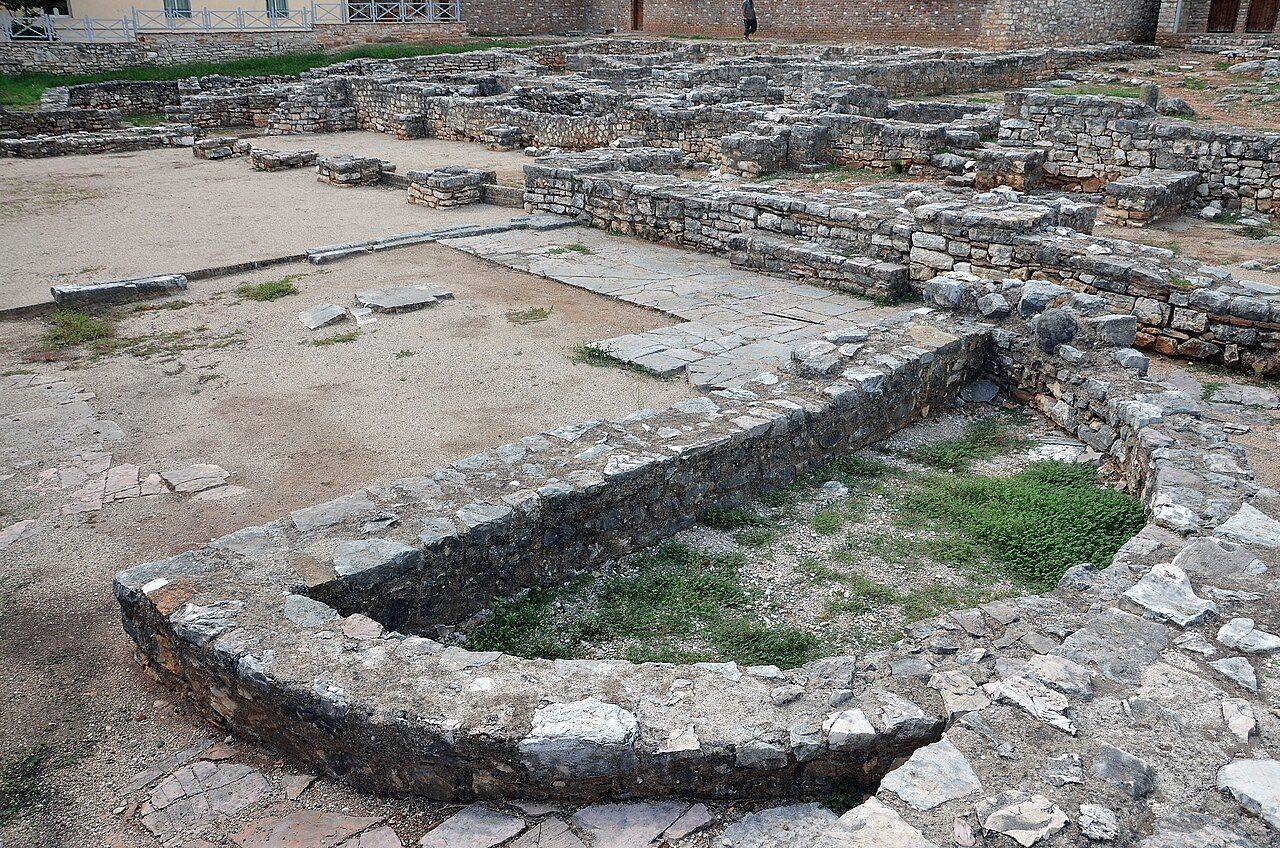
Most people walk past it without realising what it is. In the middle of Sarandë, a few minutes inland from the seafront, a fenced plot of low stone walls, a few palms and patches of grass sits between apartment blocks and busy streets. These are the remains of ancient Onchesmos, the town that stood here long before modern Sarandë, and at their heart is something rare in this part of the Mediterranean: a synagogue dating from the late Roman period, later turned into a Christian church.
It is a small site, and you can see most of it in a short visit. But it opens a window onto a version of this coast that is easy to forget amid the new buildings: a busy ancient harbour, connected by sea to the wider Roman world, where a Jewish community built a place of worship.
Onchesmos, the town before Sarandë
In antiquity this harbour was called Onchesmos, a name you will also see written as Anchiasmos. It served as a port for the surrounding region, a natural stopping point on the sea routes along the Ionian coast and across to Corfu and Italy. Ships sheltered in the bay, and the settlement grew around the harbour much as the modern town has.
The name Sarandë came much later, from the Byzantine Monastery of the Forty Saints on the hill above. Over the centuries Onchesmos faded, and for long periods the place was little more than a small anchorage. What survives of the ancient town lies mostly beneath modern streets and buildings, which makes the excavated area in the centre all the more valuable.
A synagogue, then a church
The building here is generally dated to the 5th and 6th centuries AD. In its first phase it served as a synagogue, a meeting place for a Jewish community living in the port. Jewish communities were spread widely around the late Roman Mediterranean, and a harbour town on a major sea route is just the sort of place one would expect to find them. Even so, physical remains of ancient synagogues are rare in the Balkans, which gives this site its importance.
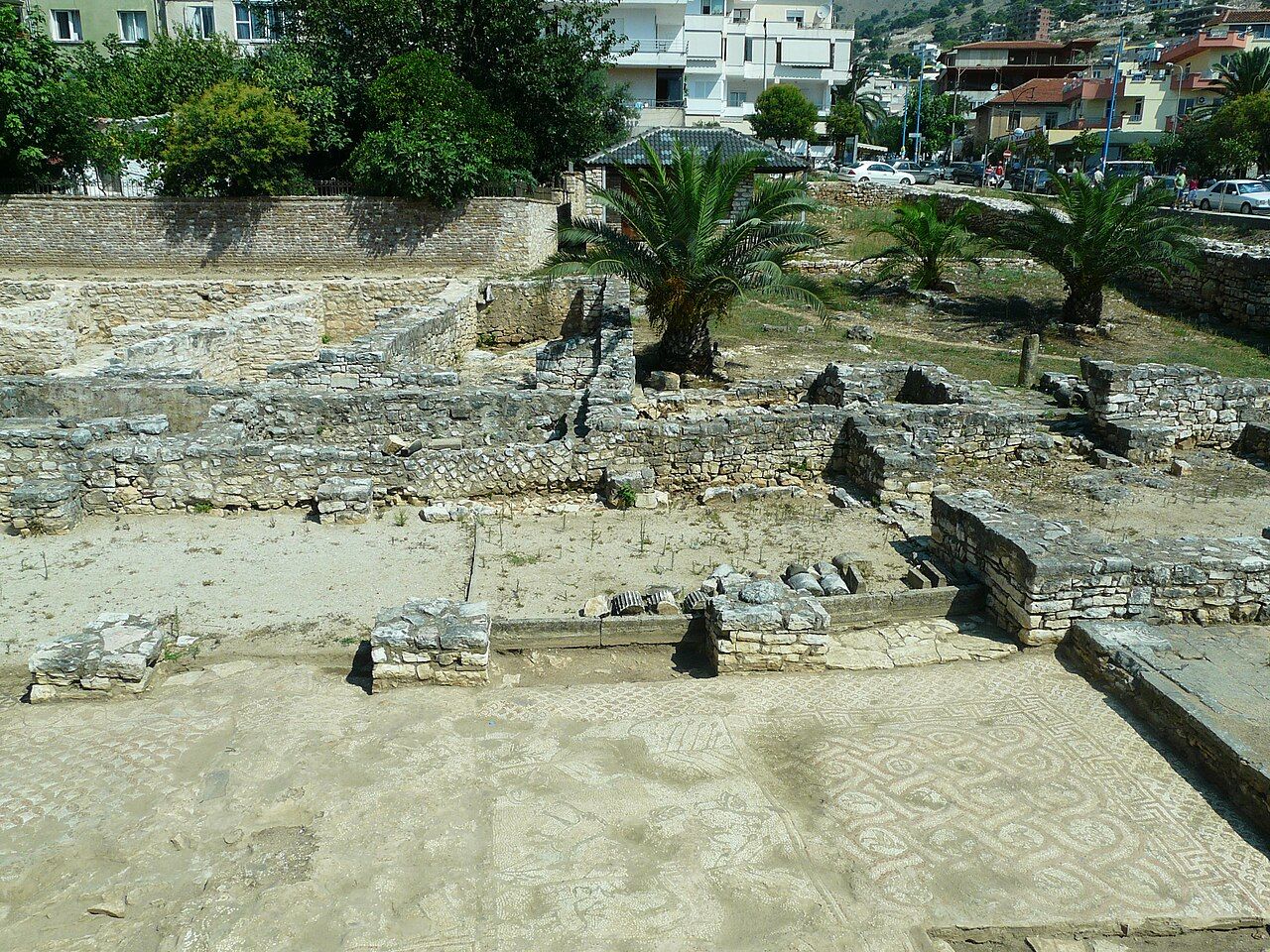
Later the building was converted into a Christian church, a basilica, and the layout you see today reflects both phases. Look for the curved apse wall, the outlines of rooms and courtyards, and fragments of paving. The changes tell the story of a town shifting with the religious life of the late Roman and early Byzantine world.
Onward · SarandëThe Monastery of the Forty SaintsFloors of small stones
The finest finds at the site are its mosaic floors. Geometric patterns of interlaced bands, knots and borders cover parts of the ground, and among the decoration found here are motifs linked to Jewish worship, including a menorah, the seven-branched lamp. Later phases added Christian decoration, so the floors are themselves a record of the building's two lives.
Mosaics are fragile, especially in the open air. Sun, rain, frost and feet all wear them down, so the floors are often covered with protective layers of sand or sheeting and only partly visible, if at all. Do not be disappointed if you see bare earth where you hoped for colour; the covering is what keeps the mosaics for the future. Whether any sections are exposed when you visit varies, so treat a glimpse as a bonus.
Discovery and excavation
The remains came to light in the 1980s, during building work in the town centre, a reminder of how much of the ancient town still lies under modern Sarandë. Systematic excavation began in 2003 and continued over the following years, uncovering the plan of the building, its mosaics and the evidence of its change from synagogue to church.
Work of this kind is slow, and research and conservation continue. The site you see is a snapshot of an ongoing effort to understand and protect it, set right in the middle of a busy modern town. That contrast is part of its interest: you look over the fence at fifteen-hundred-year-old walls and then turn back to traffic, cafés and the sound of building work.
A visit, step by step
The ruins are in the town centre, a short walk inland from the promenade. You can see much of the site from the surrounding streets. Information panels are limited, so a little background reading helps.
- Time to allow: twenty minutes to half an hour.
- Best time: morning or late afternoon, when the light is softer and the heat lower.
- Getting there: on foot; parking in the centre is limited.
It fits easily into a walk along the seafront promenade. Start at the ruins, wander down to the sea and follow the bay towards the port.
Layers of the past around Sarandë
Onchesmos is one piece of a much larger history around this bay. For the full picture of the ancient world on this coast, head south to Butrint, where Greek, Roman, Byzantine and Venetian layers overlap in a single site on the lagoon. On the ridge above town, Lëkurës Castle adds the Ottoman chapter, and the monastery on the hill adds the Byzantine one. Seen together, they show a harbour that has been rebuilt, renamed and reinvented many times.
The synagogue is perhaps the most surprising of these places, simply because it is so easy to miss. A few minutes spent at the fence, looking at the curve of an apse wall and imagining the floor uncovered, change how you see the rest of the town.