
On the coastThe road south is busy in July and August and parking fills by late morning. Arrive at opening, carry water and repellent, and expect heat under the trees.
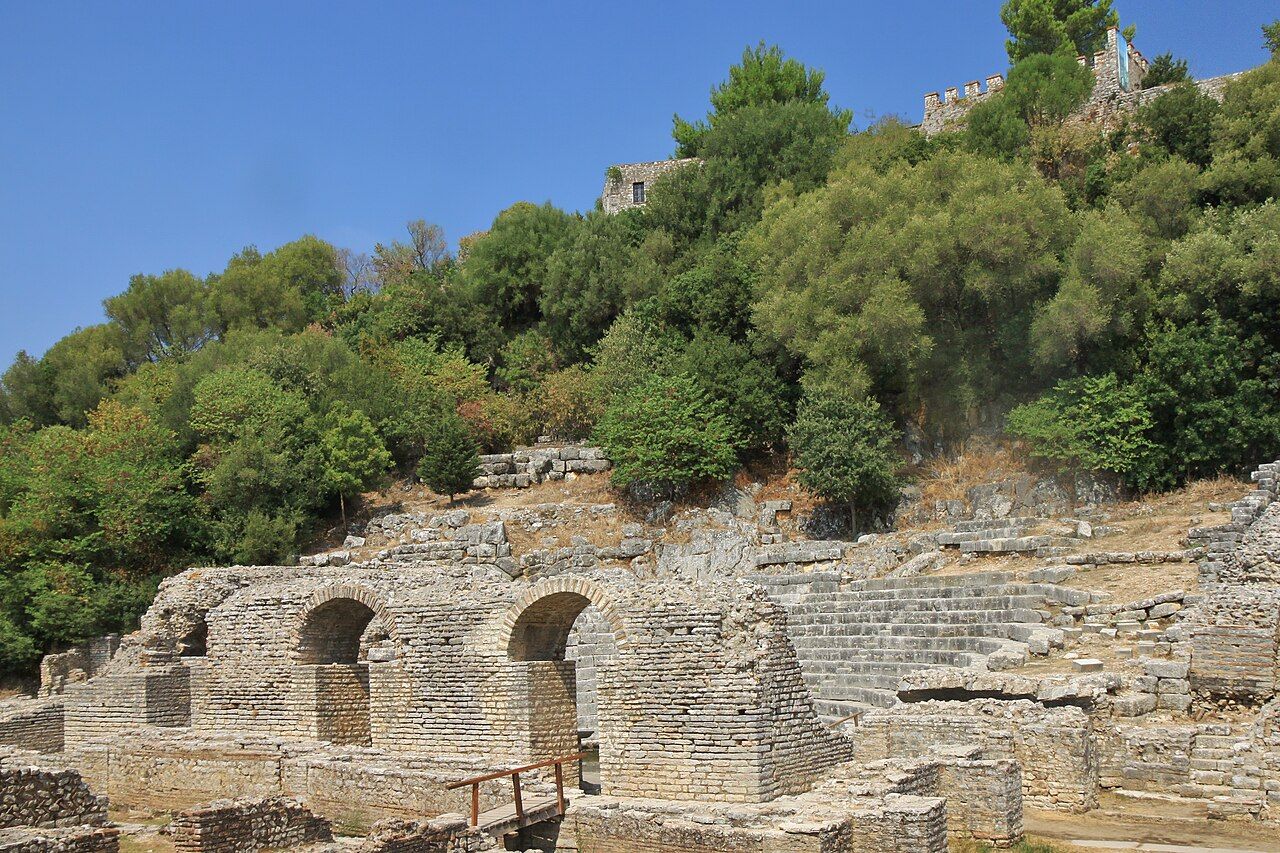
Butrint sits on a low, wooded hill at the southern tip of Albania, with Lake Butrint on one side and the Vivari Channel curling past it to the sea. It is a small place to walk, perhaps two or three hours at an easy pace, but few sites anywhere pack so many centuries into so little ground. People lived here in prehistoric times. Greek settlers made it a city called Buthrotum. Rome turned it into a colony, Byzantium gave it a bishop and a great church, and Venice kept it as a watchful outpost facing Corfu.
The whole site has been a UNESCO World Heritage site since 1992, and the hill and the wetlands around it form a national park. That protection shows. Instead of a bare field of stones under a hard sky, you walk through shade: laurel, ash and old oaks grow between the walls, frogs call from the flooded corners, and the water is never more than a few minutes away.
A city built in layers
The best way to understand Butrint is to think of it as a stack rather than a single town. Each new power built on top of, or out of, what was already there. Greek walls carry Roman repairs; Roman houses were turned into Christian buildings; medieval towers reuse carved blocks from older temples. Roman poets liked to say that exiles from Troy had founded the place, and the story gave the colony a proud pedigree even if nobody takes it as history now.
What matters for a visitor is that almost every corner shows two or three periods at once. A path around the hill takes you through all of them in rough order, from the theatre and baths near the entrance, past the baptistery and basilica, out to the gates in the city wall, and finally up to the acropolis and its museum.
- Greek city: walls, the theatre and a sanctuary on the lower slopes.
- Roman colony: baths, houses, an aqueduct and a busier town spreading across the channel.
- Byzantine bishopric: the baptistery and the Great Basilica.
- Venetian outpost: towers guarding the water and the route to Corfu.
The theatre and its inscriptions
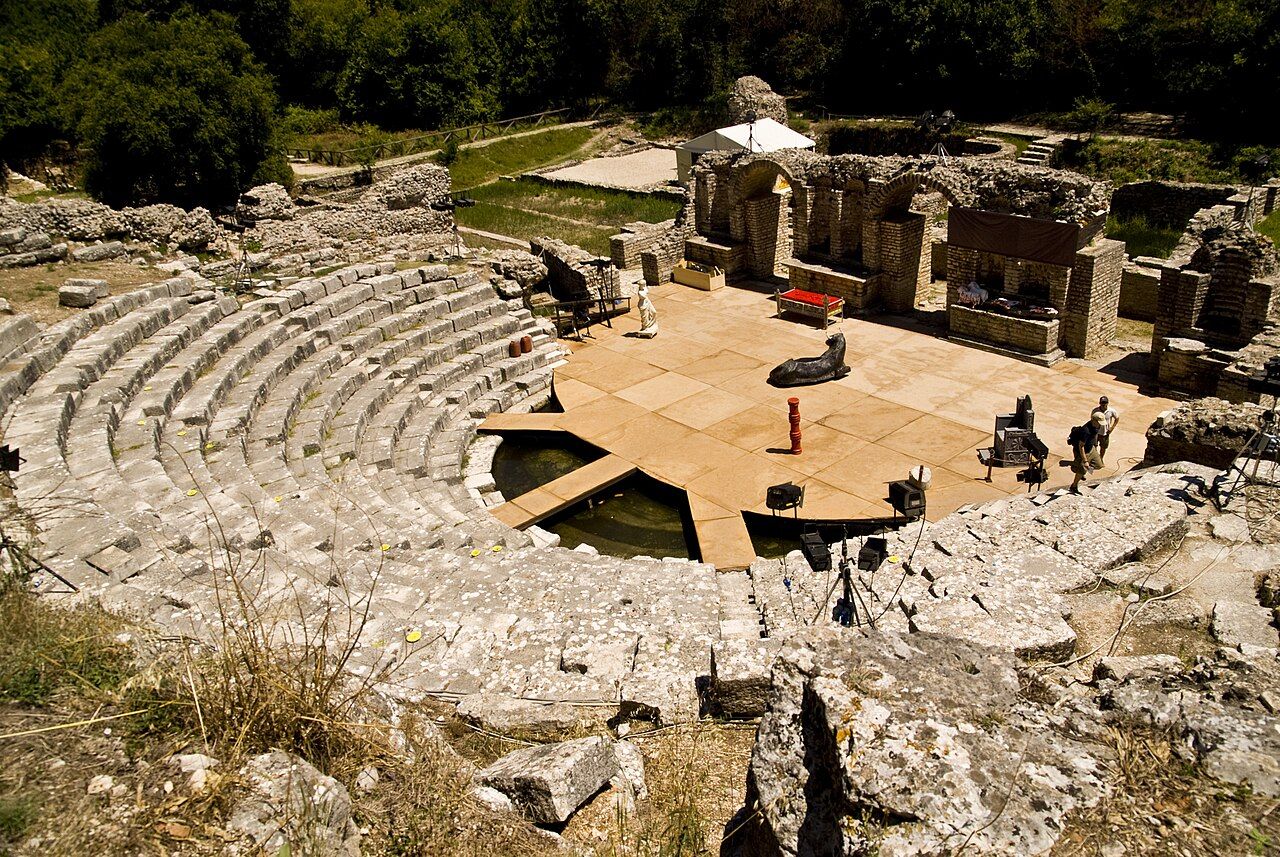
The theatre is the first great sight and, for many people, the best. It was cut into the slope in the 3rd century BC, when Buthrotum was a Greek city, and later rebuilt by the Romans, who added a stage building and statues. The lower seats are often half in water, because the ground here sits barely above the level of the lagoon and the water table rises after rain.
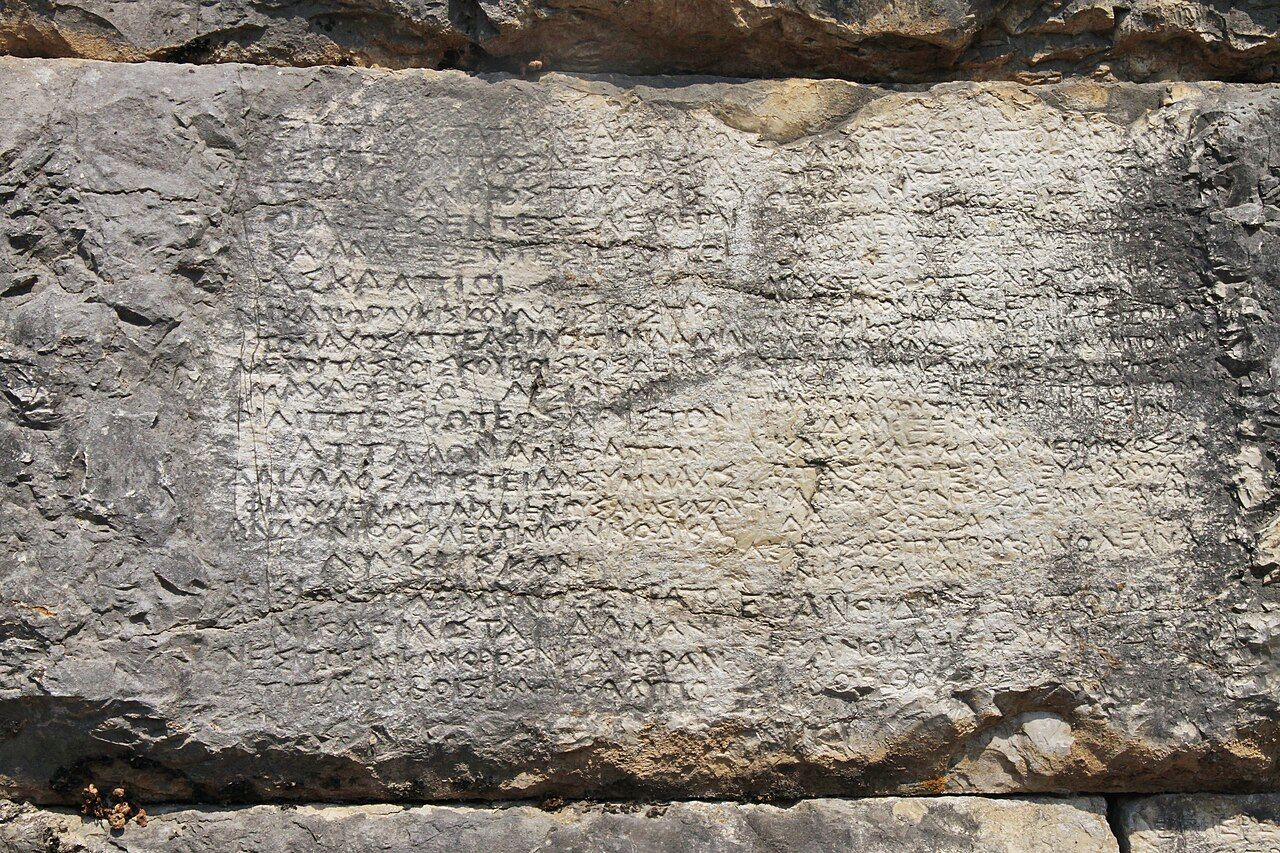
Look closely at the walls of the passage beside the seating. The stones are covered in Greek letters, small and tightly packed. These are records of freed slaves: each entry names a person given their liberty, often with the name of the owner who freed them. They turn the theatre from a monument into a public notice board, and they are one of the most human things on the site.
In some summers the theatre is used again for performances, and you may find a stage floor, lights or props set up on the old orchestra. If so, you see the space as it was meant to be used, with an audience on the stone steps and the trees all around.
Close to the theatre are the Roman baths, a cluster of low brick rooms, and further along stand the walls of a large late Roman house known as the Triconch Palace, named after its three-lobed dining hall. It faces the channel, which tells you something about who lived here: people who wanted a view and a landing stage of their own.
The baptistery and the Great Basilica
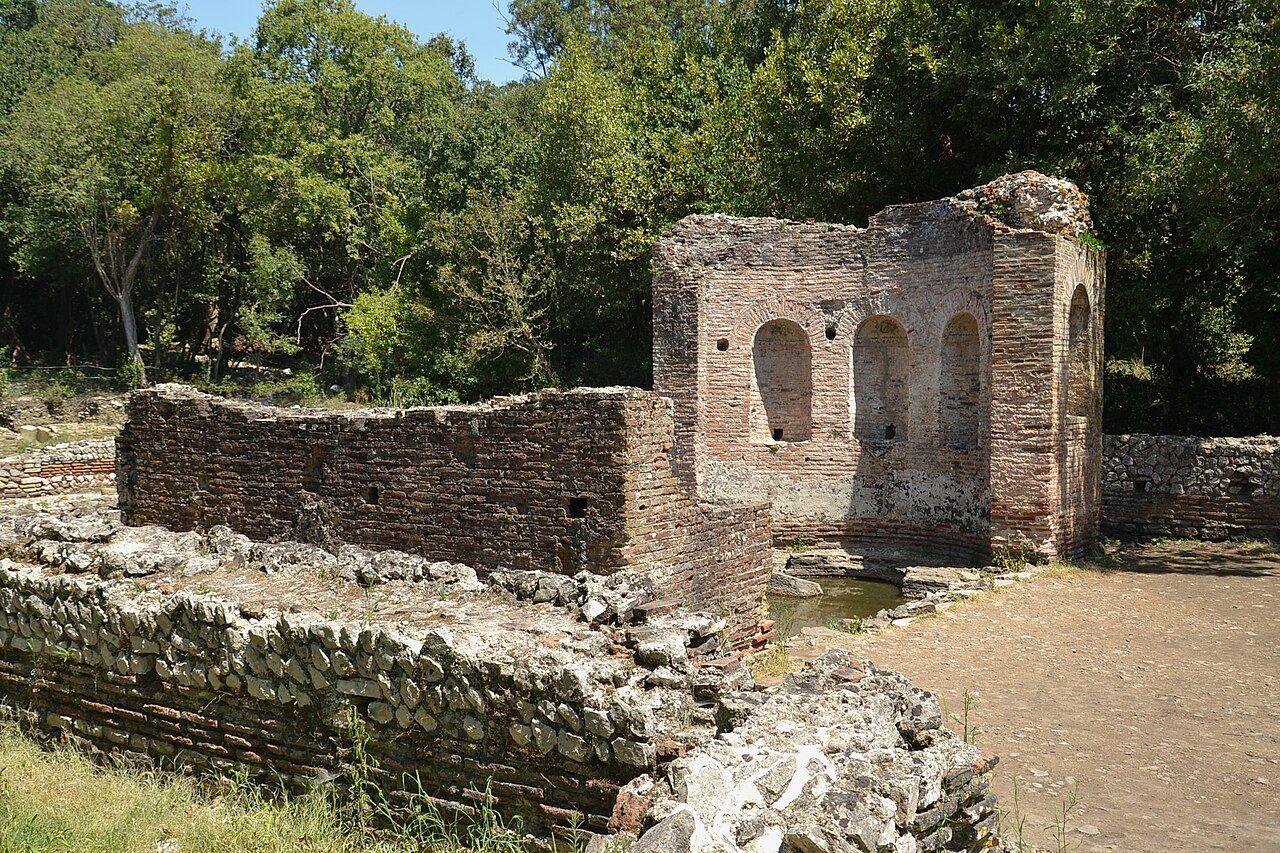
A little further on, inside a ring of trees, is the baptistery. Built in the 6th century, it is one of the larger early Christian baptisteries anywhere, a round hall with two rings of columns around a central font. Its floor is a mosaic of birds, animals and vines set in interlocking circles.
You will almost certainly not see it. To protect the mosaic from feet, weather and plants, it is usually kept under a layer of sand, and uncovered only on rare occasions. Do not be disappointed; the column bases and the shape of the room are still clear, and knowing what lies a few centimetres under your feet is part of the pleasure.
Onward · Butrint & KsamilThe Butrint lagoon and its mussel farmsBeyond the baptistery rises the Great Basilica, a long church with tall walls still standing to a good height. It was built in the early Christian period and repaired in the Middle Ages, and its nave and apse are easy to read. Stand at the west end and look down the length of it towards the east window, and the scale of the Byzantine town comes into focus.
Walls, gates and the acropolis
The city wall loops around the hill, and several gates survive. The most famous is the Lion Gate, a narrow passage whose lintel carries a relief of a lion biting into the head of a bull. The carving is older than the gate it now sits in; someone reused it, perhaps for its strength as a symbol, perhaps simply because it was a good block of stone. On busy mornings tour groups queue to pass through it, so if you want it quiet, go there first or last.
Each new power built on top of, or out of, what was already there.
Along the water stand the Venetian towers, square and plain, built when Venice held this corner of the coast and wanted to watch the channel and the fisheries. From there a path climbs to the acropolis. The castle on top looks medieval, but it is a 20th-century reconstruction, and it now holds the site museum, with finds from every period: statues from the theatre, pottery, coins and carved stone. The terrace in front gives the best view of the whole park, with the lake on one side and the channel winding towards the sea on the other.
Practical sense: heat, mosquitoes and the channel
Butrint lies roughly 20 to 30 kilometres south of Sarandë, about half an hour by car on the coast road through the village of Ksamil. Buses run the same road in season.
The site has a ticket office at the entrance. Allow at least two hours inside, three if you want the museum and the walls.
- Go early. In July and August the heat builds fast, and the mid-morning arrivals from the coast make the paths crowded.
- Bring repellent. The marshy ground breeds mosquitoes, and they are at their worst in the evening and after rain.
- Wear proper shoes. Paths are uneven and the stones can be slippery near the water.
- Carry water. There is shade, but the air under the trees is humid.
Just outside the site, a small cable ferry hauls cars and people across the Vivari Channel towards the south and the Greek border. It is a slow, simple crossing on a flat platform, and it gives you a low view of the channel and the walls from the water. Times and running depend on season and conditions.
Butrint pairs well with other sites of the same long story. In Sarandë itself, the remains of the ancient synagogue show the town's own past, and the hilltop Lëkurës Castle gives a view down to the lagoon you have just walked beside. If you are planning the whole trip, read our notes on seasons and the Corfu ferry, since the island you can see from Butrint's walls was part of the same Venetian world.