
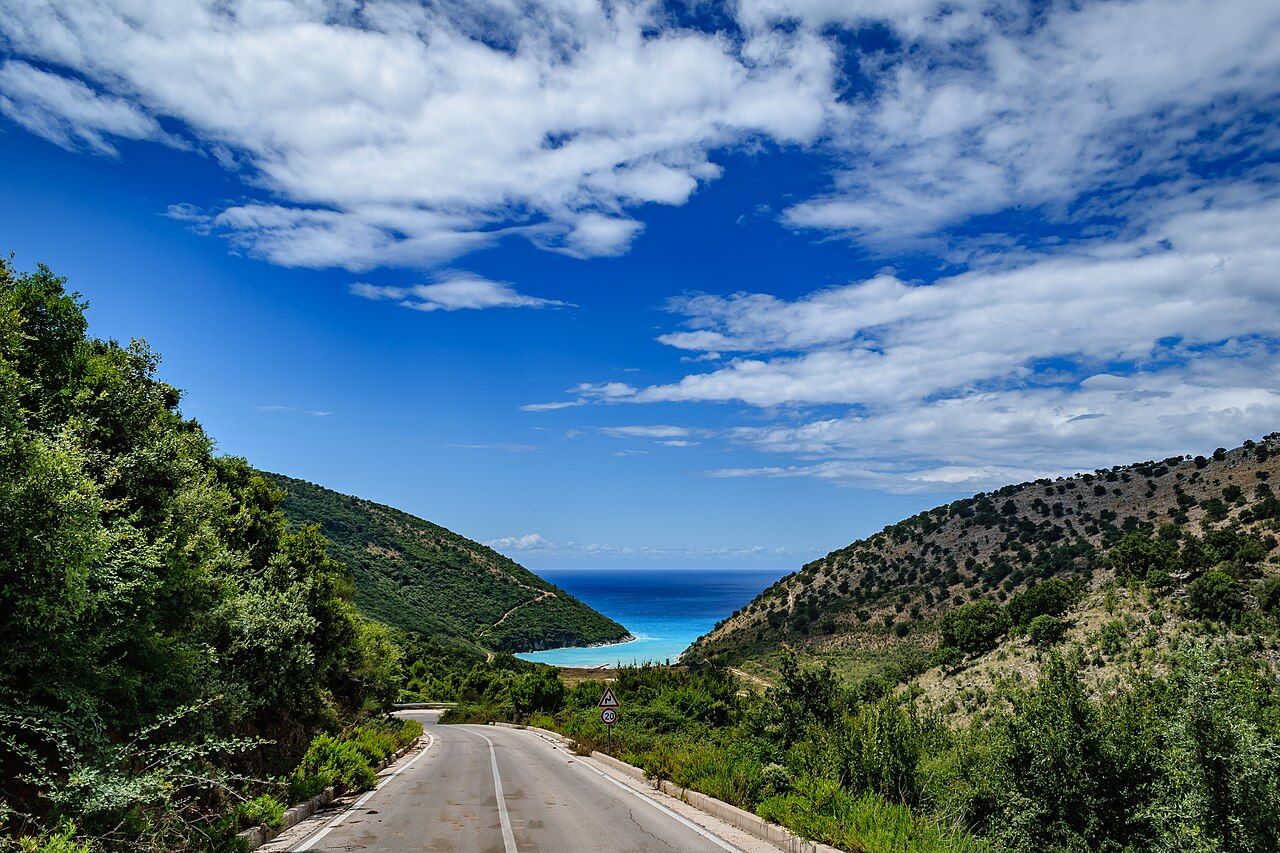
On the coastLeave early in July and August, when traffic slows on the bends and beach parking fills by mid-morning. Fill up in the larger towns and carry water, shade and cash.
From the north end of Sarandë the road begins to climb almost at once, and within a few minutes the town and its bay are behind you. Ahead lies SH8, the coastal road that runs north along the Albanian Riviera to Vlorë: past the olive terraces of Lukovë, the long shore at Borsh, the small bay of Porto Palermo, the town of Himarë, the white coves of Dhërmi, and finally over the Llogara Pass, about 1,000 metres up, before dropping to the Bay of Vlorë.
It is not a fast road, and it should not be driven as one. The reward is the view: mountains falling straight into a sea that shifts from turquoise to deep blue, villages stacked on the slopes, and side roads that wind down to beaches you can see long before you reach them.
A road rebuilt, but still a mountain road
For much of the twentieth century this coast was hard to reach. The road was narrow, broken in places and slow, and the villages along it were linked as much by footpaths and boats as by tarmac. Through the 2000s and 2010s long sections were rebuilt and widened, and today most of SH8 is a proper two-lane road with a decent surface, barriers on many of the worst drops and signs at the main junctions.
What the rebuilding could not change is the shape of the land. The road still follows the mountainside, turning in and out of every valley, with tight bends, short blind crests and long steep drops to the sea. Some stretches have no shoulder at all. Expect to drive in second and third gear for long periods, and expect the distance on the map to take longer than it looks. Without stops, Sarandë to Vlorë takes roughly three to four hours; with a swim or two and lunch, it fills a day.
Road manners on SH8
You will not be alone on it. Local drivers know the bends and often take them faster than visitors would like, and overtaking on short straights is common. Let them pass; there is no prize for holding a line. Pull into a lay-by if a queue builds behind you, and use your horn lightly before blind corners where the road is narrow.
Animals are part of the traffic too. Goats spill across the tarmac on the higher sections, cows wander along the verges near villages, and a flock with a shepherd behind it can close the road for a few minutes. Slow down when you see droppings on the road, because the animals are usually just around the next bend. At dusk this matters even more: lighting is limited outside the towns, and a dark cow on a dark road is hard to see.
Buses use SH8 as well. Coaches and the smaller minibuses known as furgons run between Sarandë, Himarë and Vlorë and stop in the villages along the way. They are slow on the climbs and wide on the bends, and they give you a rough sense of how locals travel the coast. If you prefer not to drive, they are a workable way to move between the main towns, though timetables are informal and change with the season, so ask locally the day before.
Fuel, food and breaks
Fuel stations are found in and around the bigger places, such as Sarandë, Himarë and Vlorë, and at points between them, but there are long gaps, especially on the climb towards the Llogara Pass. Leave with a full tank and top up whenever you pass a station on a long day. Card payment is common in towns but not guaranteed everywhere, so carry some cash in lek.
Breaks come naturally. The olive village of Lukovë, with Bunec below it, is the first good stop north of Sarandë. Further on, the long shore at Borsh has room to stretch out, and the small fortress on its peninsula at Porto Palermo makes a short, rewarding detour. Each of these has a side road down from SH8; some are steep and narrow, so take them slowly and leave room for cars coming up.
Onward · The RivieraDhërmi, Jale and the white-pebble covesParking in high summer
In July and August the coast is busy, and the hardest part of the drive is often the last few hundred metres. Roads down to the most popular beaches can back up at mid-morning, and parking near the sand is limited, often in informal lots where an attendant may ask for a fee. Arriving early solves most of this. By nine or ten in the morning the best spaces are gone, and by noon you may be parking well up the hill and walking down in the heat.
Out of the peak weeks the picture changes completely. In May, June, September and early October you can usually park close to the beach, the bends are quieter, and the light on the water is softer. If you can choose when to drive the coast, choose then.
The concrete domes along the coast
Look out over almost any headland on SH8 and sooner or later you will see a small concrete dome with a narrow slit facing the sea. These are bunkers, built in their hundreds of thousands across Albania during the communist period under Enver Hoxha, when the country was sealed off and its leaders expected invasion from almost every direction. Few were ever used for their purpose. Some have been broken up, a few have been painted or reused, and many still sit in fields, on beaches and on the slopes above the road.
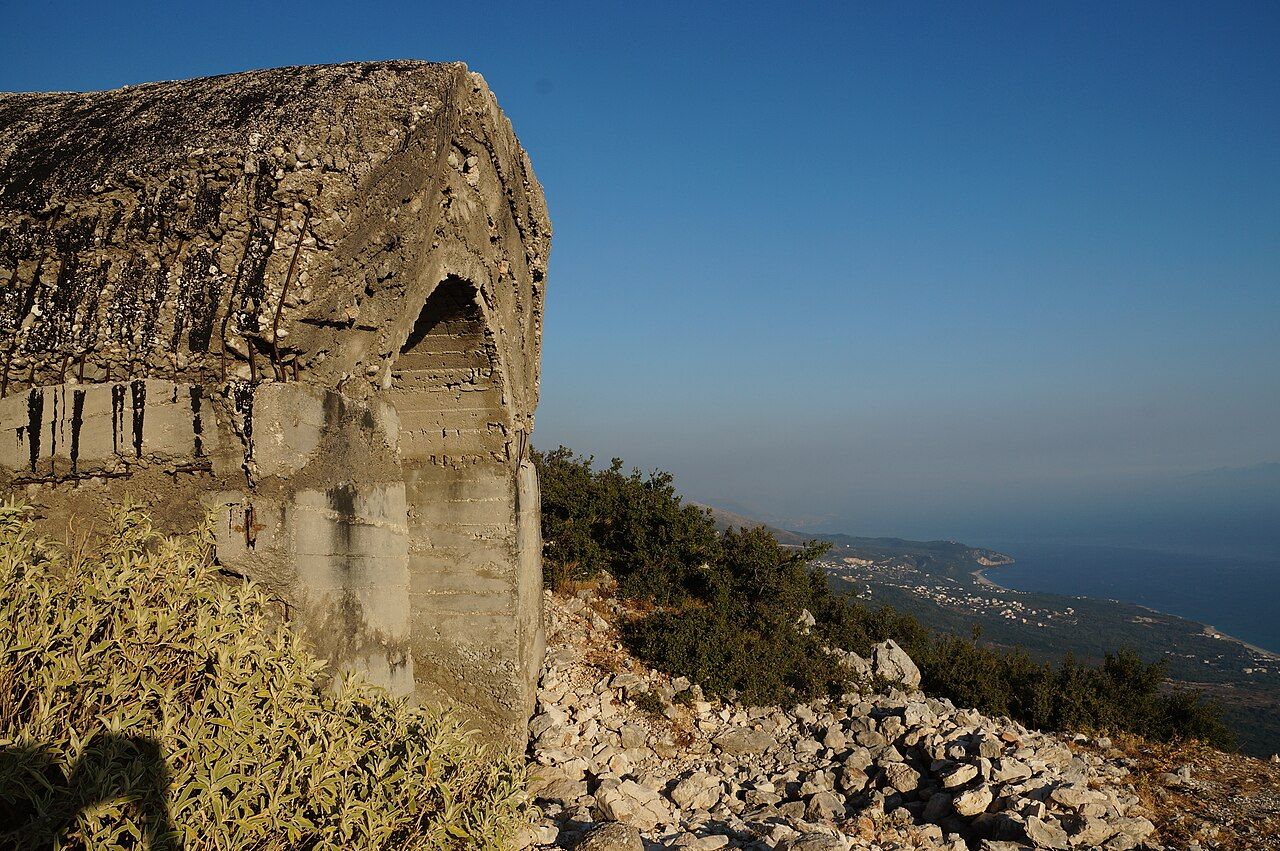
They are a plain reminder of a closed era, and they are found right up to the higher ground. Near the Llogara Pass, old military posts overlook the whole sweep of the Riviera. Treat them with care if you stop: interiors can be dirty, uneven or flooded, and some stand on unstable ground.
Practical notes for the drive
- Drive in daylight where you can. Bends, animals and limited lighting make night driving slower and more tiring.
- Carry water, sunglasses and something for shade. Lay-bys offer views but rarely trees.
- Take the climb to the pass slowly in both directions, and use low gears on the descent rather than riding the brakes.
- Allow extra time for side roads to beaches; they are often steeper and narrower than SH8 itself.
For the town at the centre of the drive, with its old quarter on the hill and its beach below, see our guide to Himarë. Taken slowly, SH8 is less a transfer between towns than the main event: a long, curving balcony over the sea.