
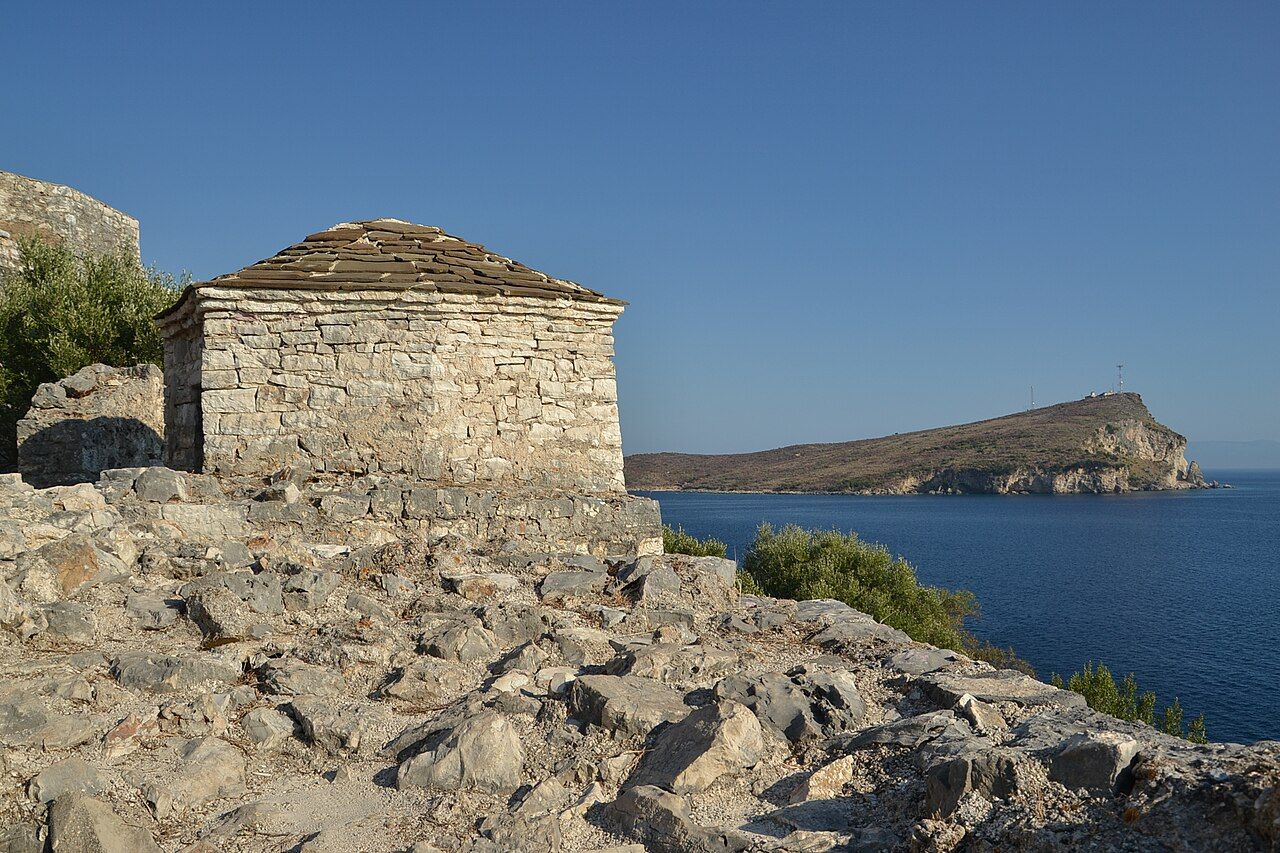
On the coastSH8 bends hard around the bay and the parking area is small. Come early in summer, carry water, and expect little shade on the peninsula or inside the fortress walls.
Driving north from Sarandë on the SH8 coast road, you pass Borsh, climb over the headland beyond it and drop towards a bay that looks almost like a lake. The hills close around it on three sides, the water inside lies flat even when the open sea is ruffled, and on a low green peninsula in the middle stands a squat, pale fortress. This is Porto Palermo, one of the most sheltered anchorages on the whole Albanian coast, and one of the easiest places on the Riviera to see several centuries of history in a single short walk.
There is no town here, only the bay, the fortress, a small church, and the road curving around the shore above them. That emptiness is part of the appeal. You come for an hour or two, walk out along the peninsula, climb the walls, swim from the rocks, and drive on towards Himarë or back south with the sense of having seen something odd and particular.
A harbour that everyone wanted
Look at a map of this coast and the reason for the fortress becomes clear. Between Sarandë and Vlorë the shore is mostly open, steep and exposed to the westerly and southerly winds. Porto Palermo is the exception: a deep inlet with a narrow mouth, protected by a headland, where ships could ride out a storm. Any power that wanted to control the sea lanes between the Adriatic and the Ionian, or simply to land men and supplies on this stretch of coast, had a reason to hold it.
Greek, Roman, Byzantine and Venetian sailors all knew the bay, and its old name, Panormos, was one Greek sailors gave to good, sheltered harbours. Later the Ottomans controlled the coast, and at the turn of the 19th century the most powerful figure in the region was Ali Pasha of Tepelena, the ambitious governor who ruled much of southern Albania and northern Greece from his base at Ioannina and acted, for long stretches, almost as an independent prince.
The fortress on the peninsula
The fortress is usually attributed to Ali Pasha and dated to the early 19th century, a period when he was strengthening his hold on the coast facing the Ionian islands. Some accounts suggest he built on top of earlier Venetian works; the stone you see today, though, is mostly from his time. It is a compact building, triangular in plan, with thick sloping walls and rounded bastions at the corners, designed to sit low and resist cannon fire rather than to look grand.
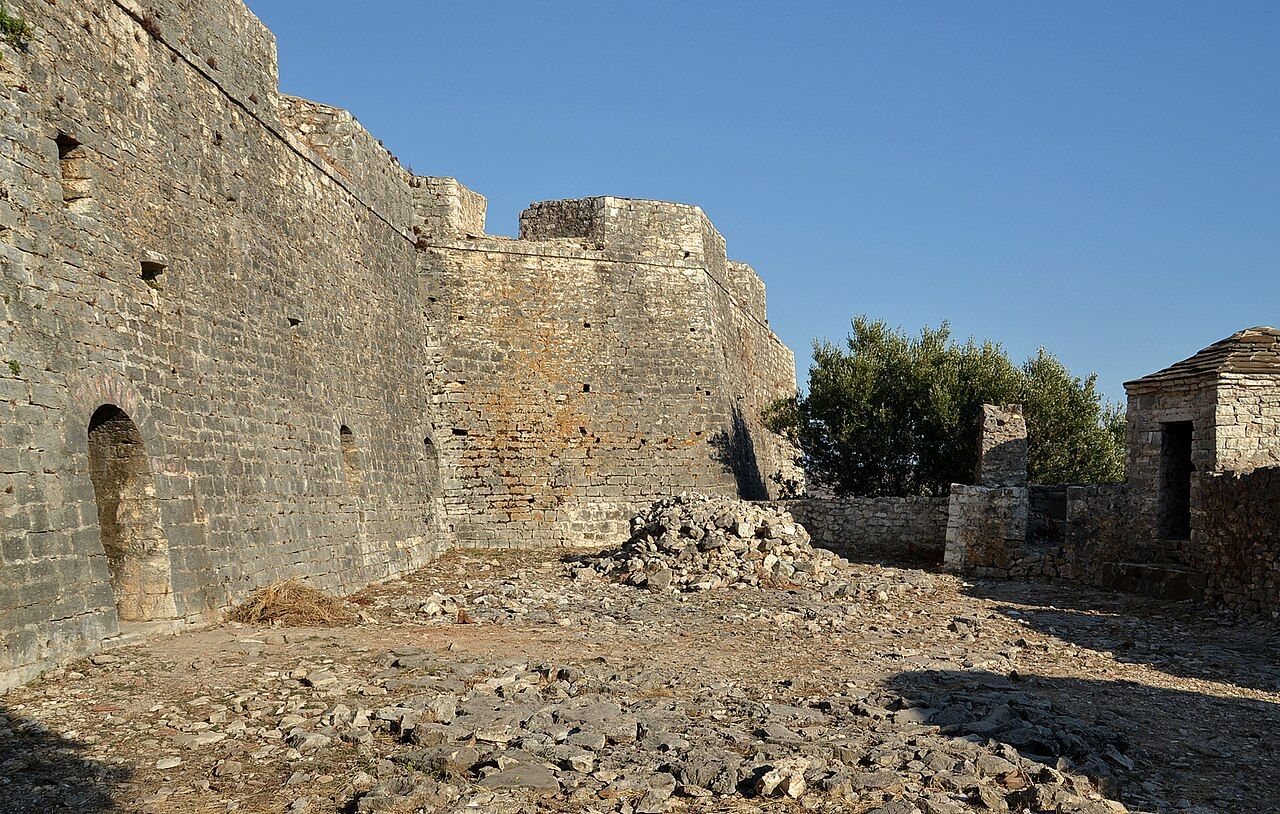
You reach it on foot along a short track from the parking area at the neck of the peninsula. A ticket is usually sold at the entrance in season. Inside, a dark vaulted passage leads into a central courtyard of rough stone, with doorways opening into rooms and chambers set into the thickness of the walls. Bring a torch or use your phone light: some of the rooms are completely dark, and the floors are uneven.
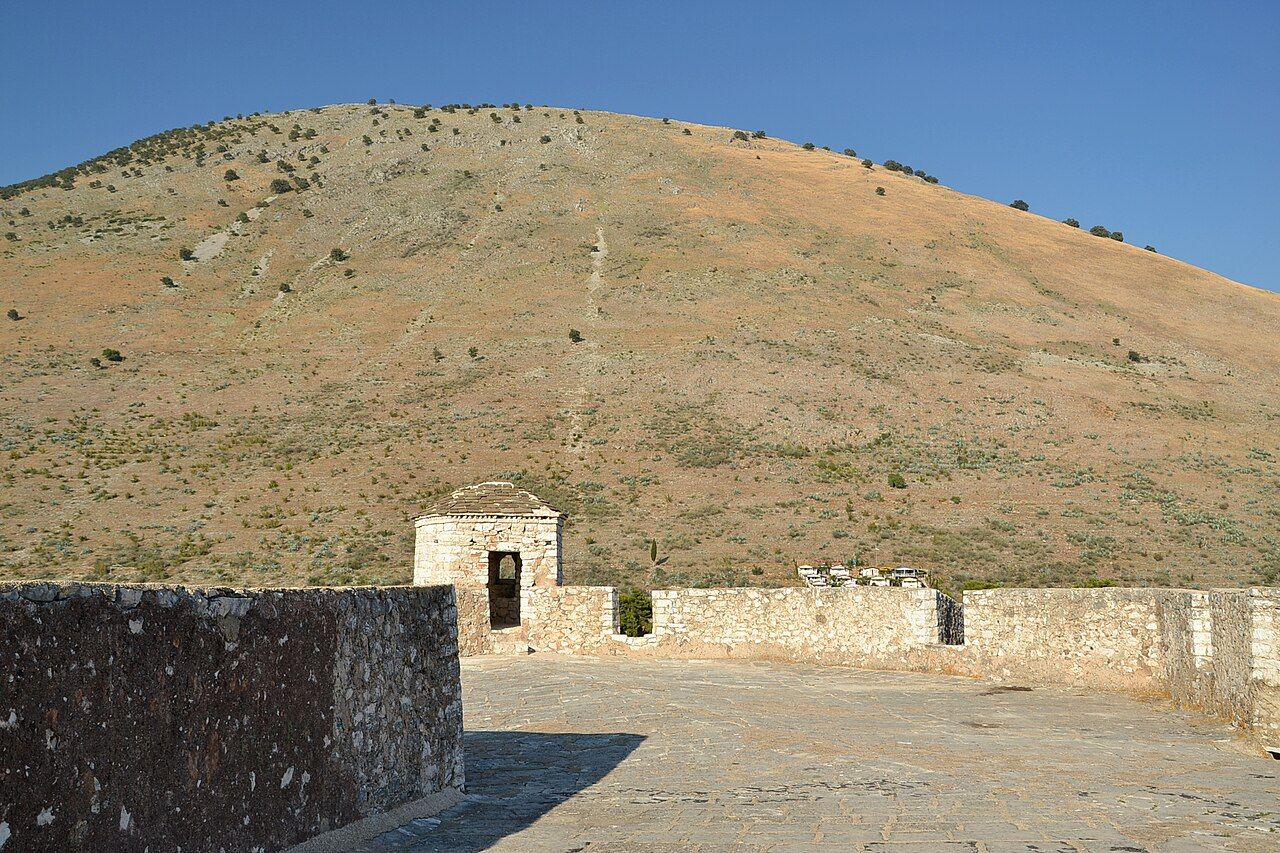
From the courtyard, steps lead up to the roof. This is the best part of the visit. The walls are broad enough to walk along, and small stone sentry boxes with slab roofs stand at the corners, each with a narrow opening facing out over the bay or the open sea. From up here you understand the whole site at once: the ring of hills, the narrow mouth of the harbour, the deep blue water outside and the calmer green-blue water within.
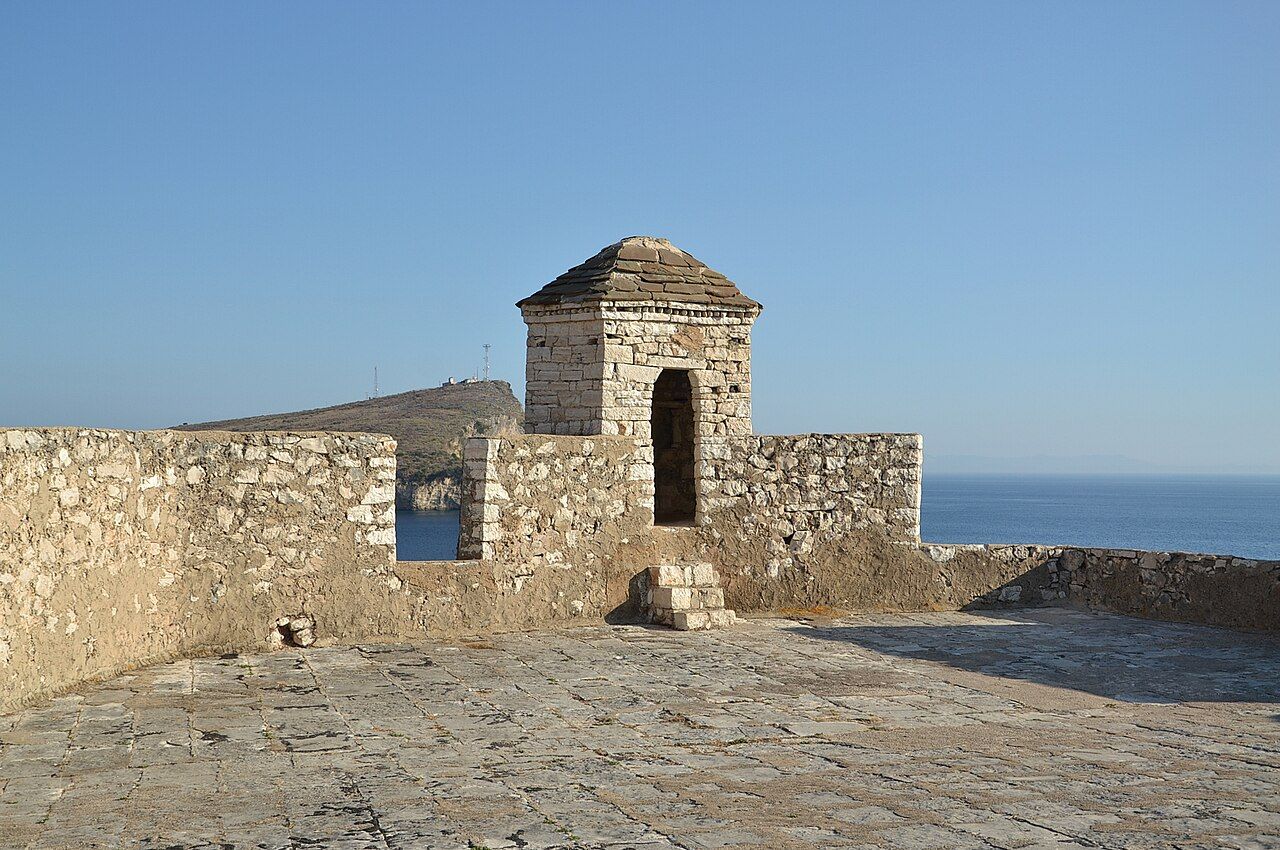
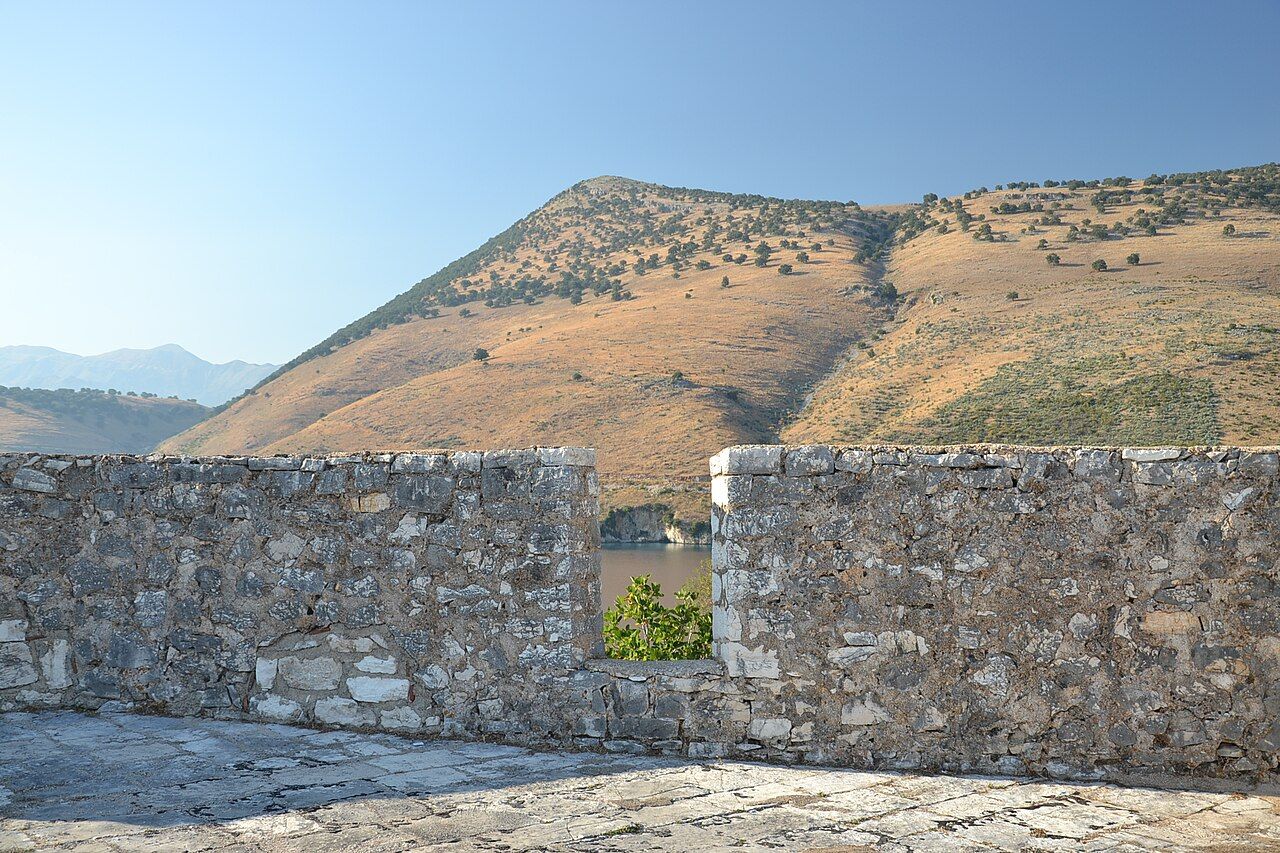
On the landward side the bare hills rise steeply, dotted with scrub and the occasional olive. On the seaward side, a long headland stretches out to the south-west with masts on its summit, closing off the bay from the open Ionian.
The tunnel across the water
From the fortress roof, look across the bay to its northern shore and you may spot a dark opening at the waterline, cut straight into the hillside. This is the entrance to a tunnel built during the communist period as a shelter for submarines. In the years after the Second World War, Albania was closely allied with the Soviet Union, and Porto Palermo, with its deep and protected water, was developed as a naval base.
That alliance broke down at the start of the 1960s, and Albania went on to cut itself off from almost everyone under Enver Hoxha's government, building concrete bunkers across the country in expectation of an invasion that never came. The base at Porto Palermo stayed in military hands for decades. Today the tunnel is disused and generally not open to the public; the area around it may still be restricted, so do not try to walk or swim into it.
Seen from the fortress, the two structures make an odd pair: an Ottoman stronghold aimed at sailing ships and a Cold War tunnel aimed at submarines, both chosen for the same simple reason. The bay's shape has not changed; only the ships have.
The bay's shape has not changed; only the ships have.
The church of St Nicholas and the shore
Near the fortress, on the slope by the bay, stands the small church of St Nicholas, a modest stone building in the Orthodox tradition. It is usually locked, but the setting is quiet and the walk to it is short. As with churches all along this coast, dress modestly if you find it open, and treat it as a place of worship rather than a sight.
The shore of the peninsula is mostly rock and shingle, with a few small coves where you can get into the water. Swimming here is a pleasure: the bay is sheltered, the water is usually clear, and there is rarely a swell inside the mouth. Entry is stony, so water shoes help. There are no lifeguards and little shade, and the open part of the bay can be crossed by boats, so swim near the shore and keep an eye out.
Practical sense for a visit
Porto Palermo is roughly halfway along the Riviera, about an hour and a quarter north of Sarandë in normal traffic. The road is good but twisting, and in July and August it fills with cars and buses; read our notes on driving the coast road before you set out. Buses between Sarandë and Vlorë pass the turn-off, but timetables change and stops are informal, so a car is far easier.
- Time: an hour for the fortress, longer if you swim.
- Heat: the peninsula is exposed, and stone walls hold the warmth. Go early or late in summer.
- Shoes: the track and the fortress floors are rough.
- Food and water: facilities at the bay are limited and seasonal, so carry what you need.
The bay makes a natural stop on a day spent working north along the coast. You can combine it with the long beach at Borsh to the south, or carry on a few kilometres to the old town of Himarë, where stone houses and churches crown the hill above another bay. If you have a whole day and an early start, the road continues past the white-pebble beaches of Dhërmi and Jale to the foot of the mountains.
Spring and early autumn are the best times to come. The hills are greener in May, the sea is warm enough for swimming from June to October, and in the shoulder months you may have the fortress roof almost to yourself, with nothing but the wind and the sound of water on the rocks below. For more on timing, see our notes on seasons and the sea.