
On the coastAn easy drive over the low ridge behind Sarandë. The site has little shade around the church at midday in summer; mornings and late afternoons are cooler and quieter.
Most visitors to Sarandë head inland for the Blue Eye or for Gjirokastër and pass within a few kilometres of Mesopotam without knowing it is there. That is a pity, because the village holds one of the most interesting Byzantine churches in southern Albania: the church of St Nicholas, Shën Kolli in Albanian, a solid building of brick and stone on a low rise in a wide valley, with carved animals set into its walls.
It takes less than half an hour to reach from town, and it can be seen in an hour. It fits easily into a morning, or into a longer day with the Blue Eye or Delvinë. You come for the architecture and the carvings, and you stay a little longer for the quiet.
The church of St Nicholas
The church dates from the thirteenth century, a time when this part of Epirus was a Byzantine borderland contested by local rulers, Western powers and later the Ottomans. It stands inside the enclosure of a monastery, of which parts of the walls and outbuildings remain around it.
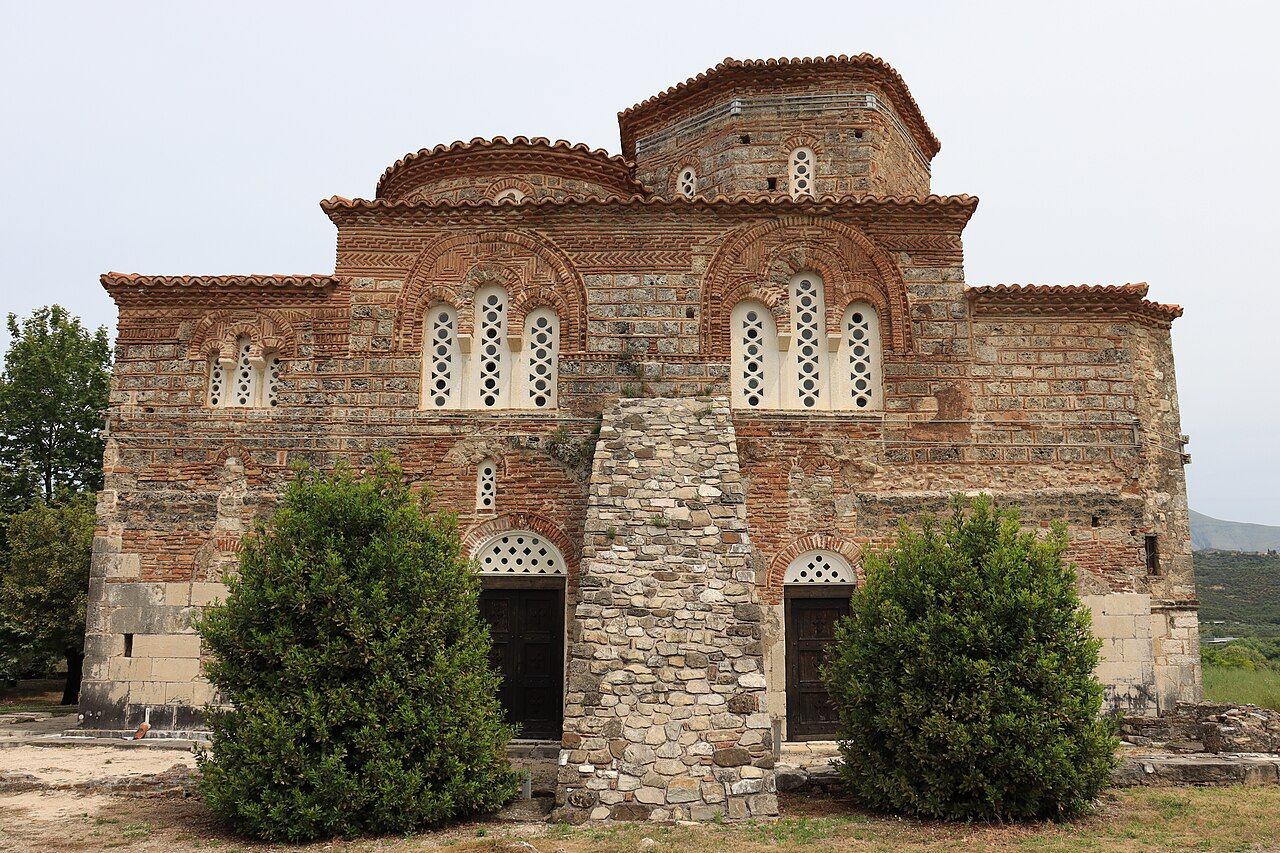
The building itself is a fine example of late Byzantine masonry. The lower walls are made of large, squared stone blocks, while the upper walls are built in alternating bands of brick and stone, with brick arches over the windows and decorative brick patterns in the gables. Look closely and you will see zigzags, rows of set bricks and small crosses worked into the courses. The roofline steps up in a series of curved gables, and the windows are filled with pierced stone or plaster screens.
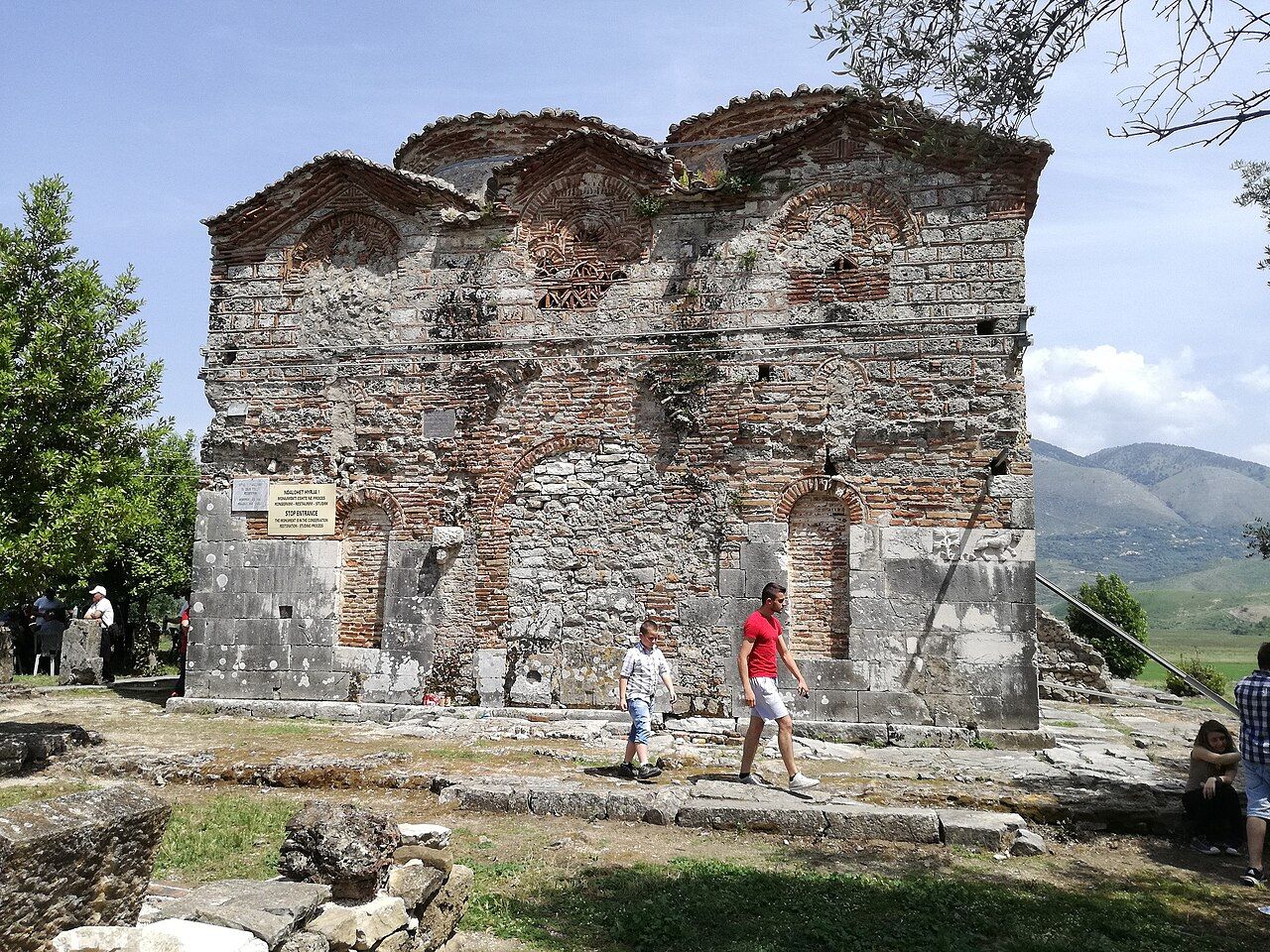
On the south side, two doorways sit either side of a heavy stone buttress, which gives the façade an unusual, divided look. The building has been studied and conserved over the years, and work on its walls continues; notices on site sometimes mark areas that are closed.
The carved beasts
What makes Mesopotam memorable are its carved stone reliefs. Set into the outside walls are panels showing animals, often described as griffins and a lion, along with other creatures and decorative motifs. They are rare in the churches of the region, and their exact origin and meaning are still discussed. Some may have been carved for the church, others reused from older buildings.
Walk all the way around the outside before you go in, and look low on the walls as well as high. The reliefs are weathered and some are small, so they reward patience and good light. Morning and late afternoon sun, striking the walls at a low angle, brings the carving out best.
The griffin, a creature with the body of a lion and the head and wings of an eagle, was a common symbol in Byzantine and medieval art, guarding sacred places and treasures. A lion carved into a church wall might stand for strength or for Christ himself. Whatever their first meaning, they give the building a slightly wild, ancient character that sets it apart from most churches you will see on this coast.
Onward · InlandGjirokastër, the city of stone roofsThe valley and the village
Mesopotam lies in a broad, green valley of fields, orchards and olive trees, ringed by bare hills. The name is usually explained as Greek for "between rivers", which fits the watered land around it. In spring the valley floor is lush; by late summer it turns golden and dusty.
The village is a working place rather than a resort, and the church grounds are used by the local community, including for celebrations on feast days. If you arrive on one of those days you may find music and families gathered under the trees. Be respectful of services and gatherings, dress modestly if you go inside, and ask before photographing people.
Calling in
The church sits a short distance off the road that runs from Sarandë towards the hill town of Delvinë. Signs point the way, though they are not always prominent, so it helps to have a map ready. Parking is informal and usually easy outside the busiest days.
Access to the interior varies. Sometimes the church is open and a custodian is present; at other times you can only see the outside. There may be a small charge or a donation box. Even from outside, the visit is worthwhile for the masonry and the carvings.
Bring water and a hat in summer. The grounds are open, with some trees, but the area around the church walls can be hot at midday. Wear shoes suited to uneven ground, as old stones and foundations lie around the enclosure.
Combining it with other sights
Mesopotam pairs well with other places inland. The road continues to Delvinë, a small town with an Ottoman-era mosque and views over the hills. In the other direction, the turn for the Blue Eye spring is not far, and a morning at the spring followed by the church makes a good half day.
If the Byzantine layer of the region interests you, the ruined Monastery of the Forty Saints above Sarandë and the churches and baptistery at Butrint complete the picture. Together they show how deeply Christian Byzantium shaped this coast long before the Ottoman centuries and the modern towns.
A quieter side of the south
The coast around Sarandë is busy in summer, with traffic, music and crowded beaches. Mesopotam is the opposite. You may well have the church to yourself, with only birdsong and the wind in the olive trees for company. That quiet, and the strange carved beasts watching from the walls, make it one of the more rewarding short trips from town.
Go in the morning, take your time walking around the walls, and then head on inland or back to the sea. The church has stood here for more than seven centuries; it will reward an unhurried hour.